On Monday, I had my first class in Jams, Jellies, Chutneys and Tarts. I'm really excited about this class because I don't have any experience in making jam, jelly, marmalade, etc, and I think it's a pretty fascinating process. And I'll soon have a lot of use for the Ball jars my parents have had for years, when they used to jar tomatoes for sauces and stews.
During class, we made a few different types of raspberry jam, some with seeds and some without. For this we used individually quick frozen raspberries; IQF products are great because the fruit is frozen at a point of ripeness, so flavor is actually really really good. We first heated the raspberries to soften them, and next pushed the raspberries through a sieve to remove the seeds. We returned the raspberries to the pot and added in sugar, liquid pectin, and a small nip of butter. Pectin is the natural gelling agent found in fruits; some fruits have more pectin than others. Pectin is a vital component in this process. The small nib of butter was used in attempts to reduce the amount of foam that rises to the surface during the cooking process.
AS the jam had a chance to set up, we started to make apple butter. Luckily, we had leftover apples from a previous event so we didn't have to spend a lot of time peeling and dicing the apples. We combined the apples with liquid (usually cider but we substituted natural juices this time) in a pot and cooked them until a mushy consistency. We then ran the apples through a food mill to puree. We placed the puree in the pot with sugar, cinnamon, cardamom, lemon zest and salt, and we stirred the mixture for almost 1.5 hrs until it reached the right consistency.
Both were extremely yummy. Unfortunately no pictures this week, but hopefully in the future.
Sunday, January 30, 2011


Thursday, January 27, 2011
Fondant Fancies
Last Saturday, my friend Gilly invited me over to her house for some experimental baking. For Christmas she received a cookbook of Peggy Porschen, who has a fabulous cakes business in England. If you want to see what the cookbook entails, check out the products on her website; seriously, this stuff is amazing.
Gilly wanted to try the recipe for Fondant Fancies, which are classical Petit Fours - small layered cakes, topped with marzipan, and covered in colored poured fondant and decorated. After baking the cake and making the buttercream, we layered the cake, which was roughly 8 in x 8 in.

I made the marzipan from almond paste (which Gilly had previously made) and confectioner's sugar. We next added the layer of marzipan and apricot jam, and sliced the cake into 16 squares:

We next created four different colored batches of poured fondant. The next step was to dip each square into the fondant to get a smooth coating:


And finally, we melted some chocolate to pipe designs on the top of each:


After a full day's effort, our final products like this:

Not too shabby, right? Seriously, this was an amazing day of experimental baking. Not only did we try something fairly challenging, we had a lot of fun doing so and got to practice lots of good skills. We baked and sliced a cake, we made buttercream, we made marzipan, we made the poured fondant, and we practiced our decorative piping skills. It was definitely a day well spent. And, we'll be making classical petit fours like this in class tomorrow so Gilly and I will be ready with what to expect, which is most excellent!
Wednesday, January 26, 2011
Macarons, Marshmallows, Red Velvet Cake, Plated Desserts at Vintner's Dinner
In my first Petit Fours class and my second Advanced Bakeshop class, we made French/Parisian Macarons, Gran Marnier Marshmallows and Red Velvet Cake. Magazines like Bon Apetit say that macarons are going to be the next big "thing" in the food world, much like cupcakes have been in recent years. If you're unfamiliar with a French Macaron, a quick Google image search will show you thousands of pictures like this one:

French Macarons can be made in thousands of different colors and flavors. To be considered a macaron, the cookie must be made of a meringue with nut flour (usually almond) and piped into a circle and then baked to have a crisp shell and a soft center. Two of these cookies are sandwiched together with a flavored ganache or buttercream. We experimented with chocolate macarons as well as vanilla ones, and we ultimately decided to produce the vanilla ones with a lemon buttercream filling. The bakery Laduree in Paris, which is shown in the photo above, is the most famous place for macarons. They have a really neat website, if you're interested in learning more - just be sure to change the site to English - unless you're skilled in French. Here are some photos of the Macaroon production during class:


The Gran Marnier Marshmallows are made from gelatin, sugar, corn syrup, water and the Gran Marnier and vanilla for flavoring. After setting up, these were cut into bite-sized squares.
The Red Velvet Cake was made in sheet pans, and then we used circular cutters to cut small bite-size pieces of cake. A cream cheese frosting was piped on top and then garnished with a chocolate decoration.
These three bite-sized desserts, along with the truffles from my Candies and Confectionaries class, were served at a fundraising dinner on campus last Friday, where all of the food was prepared by our department. Here's a picture of one of these trays, where you can see the variety of items:

This event, called the Vintner's Dinner, was a really great learning opportunity. It was really exciting to see the products from my classes served to guests at a high-class function. In addition, I volunteered to plate desserts for the event. Along with 30 other students and our Chefs, we plated 600 desserts for guests, which had a diced apple base, toffee crunch cookie, and bourbon mousse with garnish.

All in all, a really great two weeks of class in preparation for the dinner.
Pavlova & Hazelnut Daquoise
In my first Advanced Bakeshop class, we made Pavlova and Hazelnut Daquoise. The Pavlova is a meringue based dessert named for the ballet dancer Anna Pavlova, when she visited either New Zealand or Australia in the 1920s. We first made a Vacherin, which is the base. We did this by preparing a meringue and piping it in a circular pattern to create a well; this then baked. We next prepared a vanilla flavored chantilly cream and cut strawberries and oranges to use in our final product. We were given the freedom to create our final Pavlova any way that we liked; I tried to make something that looked like a butterfly, as shown here:

To make the Hazelnut Daquiose, we first made the dacquoise layers; this required piping meringue in circular discs which were then baked. We next prepared a praline Italian buttercream for the filling. We then candied hazelnuts to be used as garnish. To assemble, we piped a layer of praline buttercream between the two dacquoise layers, and then decorated each with confectioner's sugar and candied hazelnuts. The final product looked like this:

And here's a photo of each of my final products:

Thursday, January 20, 2011
History of Chocolate, Truffles, and Ornaments
My failure to post any updates in over a week is an indication of my general lack of enthusiasm and motivation as it relates to the past two weeks of my life. After some reflection, all I can come to determine is that I have too much free time on my hands, and rather than take advantage of the free time, I've become lazy. That may sound a bit backwards, but it's really a fairly common occurrence I've been conscious of since working professionally. Think of it this way: when you have a full day of things to do, you do them, moving from one task to the next without thinking too much about it - you just go, go, go, until the to-do list is accomplished. Days that are open and free require a much more conscious effort to stay busy (if that's your goal), or it's quite easy to fall into a trap of laziness. Now I'm not saying free days can't be spent vegging out in front of the television watching an entire season of a show on DVD. Some times, these days are much needed and much appreciated. My problem is, since school started, I've been wasting too much time in front of the television and not enough time on my baking. I'm hoping that sharing this with you - and recognizing that I'm not really happy with myself - will be the final push I need to snap myself out of this funk. Onward.
The real reason for this post is to tell you about my first two days in my "Candies and Confectionaries" class, which meets on Tuesdays from 7:30am-2:00pm. As I mentioned last week, my first day of class only met from 11:00am-2:00pm due to the winter weather conditions. As anticipated, we had an abbreviated lecture on the History of Chocolate, and I was definitely glad it was abbreviated. Don't get me wrong - the history of chocolate is actually quite fascinating - but it is extremely hard to listen to a lecture for more than 20 minutes at a time. Here are some highlights, if you're interested:
*Chocolate can be traced to the Amazon, 2000 BC.
*Chocolate was used by the Mayans, dating back to 600 AD.
*Chocolate had two main uses back in the day. Cocoa beans were used in a cold, bitter drink, and the nibs from the cocoa beans were used as a form of payment.
*Cocoa nibs were used as currency, so when a Spaniard named Cortez conquered part of Mexico, he realized if he could grow more cocoa trees, he would have more cocoa beans, and therefore more cocoa nibs, and this "currency" could be used for Spain to continue to build wealth and power. Money did grow on trees.
*Cortez brought cocoa beans to Spain in 1528, thus beginning the spread of cocoa through parts of Europe and other parts of the world.
*Cocoa spread to France, England, Italy, Philippines, Brazil, Belgium, Germany, Austria, Switzerland in the 1600s and 1700s. Americans didn't discover chocolate until 1755. In the early 1800s, cocoa spread into Venezuela and Africa.
*In 1875, Peter of Switzerland figured out how to make milk chocolate.
*In 1879, Lindt of Switzerland figured out the process called "conching" which allows for chocolate to melt on your tongue.
*Since this time, Switzerland remains the leader of chocolate production and consumption. European chocolate tends to be of higher quality than American chocolate, due to the time spent in the "conching" part of the production process.
*Today, cocoa trees are found in locations 20 degrees above and below the Equator, ideal climates for growth. Climate affects the beans, which results in different flavor profiles for different types of beans.
Posting all of that was more helpful for me than probably for you, because I'm sure I'll be quizzed on this at some point, and typing it helps me remember the highlights. If you're more curious, here's a website where I'm pretty sure some of Chef's information actually comes from.
In our second class meeting, we talked more about the properties of chocolate and we learned our first lesson in tempering chocolate. The tempering process is perhaps the most important process when working with chocolate. Classically, it is a method of warming the chocolate, cooling it down, and warming it again to proper temperatures - this ensures a proper gloss and the necessary snap in the finished product. It's quite easy to ruin chocolate during this process, so it's a bit stressful to learn. The hardest part for me is trying to learn how to gauge temperatures by feel; by using the space right below one's lower lip, you can determine the temperature of chocolate. It sounds crazy, I know, but this part of our bodies remains regulated and because chocolate melts around body temperature, you can use your lower lip to determine the temperature. We practiced this in class, and I spent much of the process feeling like it was a total crapshoot. Hopefully with more practice I'll start to figure it out.
As a class we had the task of producing 2400 truffles for an event on campus on Friday. We worked in three groups of four to make three different types of truffles - dark chocolate with Kahlua, milk chocolate with Frangelico, and white chocolate with Gran Marnier. My group worked on the dark chocolate truffles. We began by making the filling, which was piped into dark chocolate shells. After tempering the dark chocolate, we piped it to seal the truffles, and finally, we rolled the truffles in dark chocolate and set them to dry. I didn't have time to take any photos so I will try to on Friday night at the event if possible. It was a good lesson in terms of chocolate production, and also a good experience to practice working quickly and efficiently.
I've spent part of the morning working on my homework assignment for this class, which involves drawing ornaments on paper. On the first day of class, Chef gave us an 8.5 x 11 sheet of paper with 8 ornament designs on the left. Our assignment is to draw each ornament in pencil six times. In this picture is a sample of the sheet he gave us and one of my attempts at drawing these ornaments:

I promise you, it's much harder than it looks. I used my copier/printer to make different copies of this to practice, and I've spent much of the morning (and a few other moments during the week) just tracing the shapes, to try to get the form as close to perfect as possible. This is where baking and pastry school reminds me of that saying "Everything I needed to know I learned in Kindergarten." Drawing straight lines and tracing these reminds me of trying to learn to write letters initially and then the incessant learning of cursive writing from Catholic school (which I also need to relearn at some point). And I repeat, it's much harder than it looks. This is the only "take home" assignment in this class, so I know I need to try to earn the highest grade possible, because I can practice as much as I feel I need to in order to turn in the best assignment. Later in the semester, I'll be making these ornaments by piping royal icing for my practical exam, so the use of these (and the stress in doing this well) is already evident. Like I said earlier, onward.
Tuesday, January 11, 2011
The Unusual Start
Thanks to the South's battle with winter weather conditions over the past two days, the spring semester is off to an unusual start. Charleston experienced only part of the winter storm - no actual snow here - but icy conditions caused for affected roadways and closed bridges, thus altering the plans of many. On Monday morning, classes were initially canceled through 11am, which at first didn't affect me, but later, an announcement was made to cancel classes for the entire day and close the campuses completely. Therefore, I didn't have class yesterday. On a typical Monday, I would spend my day in class from 2:40pm-9:10pm, for my class called "Jams, Jellies, Chutneys, and Tarts." And because next Monday is observed for MLK, I won't actually have this class until Monday, January 24th. Crazy.
In true "school closing" fashion, I spent the day being a total bum. I had the foresight on Sunday night to borrow the first season of The Big Bang Theory from my friends Anna and Jeffrey, and needless to say, I watched entirely too many episodes in one day's time. This is one of my favorite shows, and even though I've already seen every episode, I still laughed my butt off.
I made the decision not to venture off into the world, not because I was concerned with the winter conditions, but because I was concerned of true southerners trying to drive in winter conditions. That is what's actually scary in the south - the inexperienced driver behind a wheel. I don't really think it would have been too bad, honestly, because a good part of the day could be described as a freezing drizzle. Regardless, I enjoyed a lazy day in my apartment.
Today is already off to an unusual start also. As I write this, I should be in class. But classes are canceled through 11am today. On a typical Tuesday, I would be in class from 7:30am to 2:00pm, for "Candies and Confectionaries." So I guess that means I'll be showing up at 11am for a condensed 3-hour class. I'm not complaining, however, because today's agenda item says "The History of Chocolate." Of the typical 390 minutes of class, 260 minutes were budgeted for this lecture. So I'm really fine with a shortened, condensed version of this. Seriously, my attention span is thrilled.
If all goes to plan, I'm off to main campus for my condensed Chocolate lecture, and then I'll be zipping to the downtown campus for my next class, Advanced Bakeshop, which meets from 2:40-9:10pm. Yes, if you're following, I scheduled classes for myself today from 7:30am-9:10pm. It is indeed crazy, I know. But it frees up some days later in the week which are needed for re-entering the workforce. I just hope the rest of the day goes off as planned. I need to get started, and get into some sort of routine. Let the madness begin.
Sunday, January 9, 2011
What I Did On My Winter Vacation
It has been quite some time since my last post, so I figured I'd summarize the past few weeks. So here's a synopsis of "What I Did On My Winter Vacation."
I spent about three full weeks at home in Pennsylvania. And generally speaking, it was definitely time well spent with family and friends. My first two days at home were spent immersed in the final stages of gingerbread production. You may recall from my last post that I was making gingerbread houses for my friends Kristen and Abbie to decorate with their daughters Hannah and Ellie, respectively. On Wednesday, December 15, I enlisted my dad's help to assemble the gingerbread into the actual houses. It really is amazing what royal icing can do, which is simply egg whites, confectioner's sugar, and cream of tartar. After assembling, the structures looked like this:

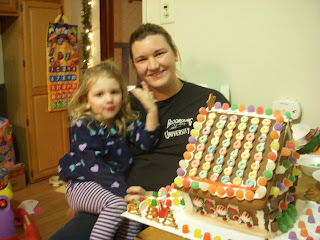
The pattern for this houses was to mimic a country cottage. On Thursday, December 16, I loaded up a bag full of icing and other decorative pieces and headed to Kristen's house for the festivities. Hannah and Ellie were more interested in eating peppermint sticks and playing with toys than really getting into the gingerbread house production, but Kristen and Abbie had great fun testing their creativity. I just generally enjoyed the whole experience.


Over the next two days, my friend Tricia and I put in two nights of drinking with the locals. On Friday, we went to see a friend's band play, and on Saturday, we went to a friend's holiday party. We had a lot of fun, and on Sunday, I was convinced I was too old for heavy drinking because I was experiencing what I thought to be a hangover that I couldn't shake. Needless to say, it wasn't a hangover, but some nasty 24-hour flu. I decided in that moment that I prefer a hangover to the flu. And unfortunately, I couldn't completely shake it, and I spent a few days in bed, trying to gain proper rest.
The remainder of my first week at home was spent helping my mom with our family's traditional Christmas cookies. I mustered the energy to make pecan tassies and peanut butter blossoms with the Hershey kisses on Wednesday, December 22. On Thursday, my cousin Jen was so kind to assist with anise oil cookies and black bottoms. It's just not a proper Christmas in our house without these cookies, and a few others, so we were able to get them all baked off in time for Christmas.
I spent Christmas Eve in traditional fashion. My dad and I made two batches of biscotti - ones with walnuts and ones with anise oil/anise seeds. My brother and I then fried off "bubbles" which are little dough balls that we put into wedding soup. My grandmother joined us for dinner and then we went to Mass at 9pm. After Mass, we did our usual gift exchange. My mom surprised me with some cute kitchen gadgets - a Hershey's cookbook and dumpling/pierogi presses.
On Christmas, my mom's family came over for a casual day. We had a large spread of porkette and mashed potatoes, and hung out playing a trivia game "Know It or Blow It" in men vs. women fashion. We celebrated our traditional Christmas on the 26th which included a ravioli dinner, gift exchange, and more trivia games.
I spent the last full week of my vacation catching up with friends, honoring old traditions, and enjoying new experiences. For example, my friend Laraine and I always go out to lunch followed by some Dunkin Donuts. And I get together usually for breakfast with Joe, one of my professors from Bucknell. In new fashion, I also got to meet my friend Kelly's son for the first time. And my brother hosted a party that was really a lot of fun and would make for a great new holiday tradition.
I spent New Year's Eve with family and friends at my favorite restaurant at home, Mattucci's, and I spent New Year's Day with family and friends one last time. Overall, my time at home was really an excellent end to an exciting year, and I feel pretty blessed to be able to go home and spend such quality time with so many people. It's really, really amazing.
On January 2nd, I drove to Raleigh to spend time with my friends Brian and Brittany. We ate at The Pit, which is an amazing bar-b-que restaurant. We dined on pumpkin cornbread with maple butter, wings, and half-racks of ribs with fries, potato salad, and baked beans. And as if that wasn't enough Southern cuisine, Brian and I had lunch the next day at the Q-Shack, where we had pulled pork sandwiches and my all-time favorite hush puppies. Feeling full and fat, I then got in my car to finish my drive back to Charleston.
I've been back in town for a week now, getting re-settled in my independent living and taking advantage of some down-time before school starts up again. My friend Mandy and I purchased "Be A Tourist in Your Town" tickets for the month of January. This $20 pass is good at 28 local attractions during the month so it's a great way to see some new sites cheaply. On Thursday, we went to the Birds of Prey exhibit where we learned about bald eagles, vultures, and owls.

We then had lunch a 17 North Roadside Kitchen, which may have the world's greatest french fries. And we then ventured off to Fort Moultrie on Sullivan's Island to learn about military coastal defense. We had the chance to see dolphins swimming really close to the shoreline as an added bonus near the Fort. On Friday, we visited the Edmonston-Alston House, which is located on The Battery. We then went to the Old Slave Mart Museum and learned a new perspective on the domestic slave trade which was prevalent in Charleston back in the day. We had sandwiches for lunch at Fast & French on Broad St. before taking a peak into the Powder Magazine (a building where gun powder was stored during the revolutionary and civil wars) and The Old Exchange & Provost Dungeon (which was a customs house and jail during the wars). In two days, we saw six different sites so we were well on our way to really getting our money's worth on these passes.
My first few days back in Charleston have been excellent, not only for the sight-seeing and slow transition back into my independent life, but also because I've had the chance to catch up with friends like Mandy, Gilly, and Anna before we begin another semester of baking and pastry chaos. The year 2010 ended well, and it looks like 2011 is already off to a great start.
If you made it through this entire novel of a post, thanks for coming back to the blog in the new year! I'm excited to share my upcoming adventures with you!
I spent about three full weeks at home in Pennsylvania. And generally speaking, it was definitely time well spent with family and friends. My first two days at home were spent immersed in the final stages of gingerbread production. You may recall from my last post that I was making gingerbread houses for my friends Kristen and Abbie to decorate with their daughters Hannah and Ellie, respectively. On Wednesday, December 15, I enlisted my dad's help to assemble the gingerbread into the actual houses. It really is amazing what royal icing can do, which is simply egg whites, confectioner's sugar, and cream of tartar. After assembling, the structures looked like this:

The pattern for this houses was to mimic a country cottage. On Thursday, December 16, I loaded up a bag full of icing and other decorative pieces and headed to Kristen's house for the festivities. Hannah and Ellie were more interested in eating peppermint sticks and playing with toys than really getting into the gingerbread house production, but Kristen and Abbie had great fun testing their creativity. I just generally enjoyed the whole experience.


Over the next two days, my friend Tricia and I put in two nights of drinking with the locals. On Friday, we went to see a friend's band play, and on Saturday, we went to a friend's holiday party. We had a lot of fun, and on Sunday, I was convinced I was too old for heavy drinking because I was experiencing what I thought to be a hangover that I couldn't shake. Needless to say, it wasn't a hangover, but some nasty 24-hour flu. I decided in that moment that I prefer a hangover to the flu. And unfortunately, I couldn't completely shake it, and I spent a few days in bed, trying to gain proper rest.
The remainder of my first week at home was spent helping my mom with our family's traditional Christmas cookies. I mustered the energy to make pecan tassies and peanut butter blossoms with the Hershey kisses on Wednesday, December 22. On Thursday, my cousin Jen was so kind to assist with anise oil cookies and black bottoms. It's just not a proper Christmas in our house without these cookies, and a few others, so we were able to get them all baked off in time for Christmas.
I spent Christmas Eve in traditional fashion. My dad and I made two batches of biscotti - ones with walnuts and ones with anise oil/anise seeds. My brother and I then fried off "bubbles" which are little dough balls that we put into wedding soup. My grandmother joined us for dinner and then we went to Mass at 9pm. After Mass, we did our usual gift exchange. My mom surprised me with some cute kitchen gadgets - a Hershey's cookbook and dumpling/pierogi presses.
On Christmas, my mom's family came over for a casual day. We had a large spread of porkette and mashed potatoes, and hung out playing a trivia game "Know It or Blow It" in men vs. women fashion. We celebrated our traditional Christmas on the 26th which included a ravioli dinner, gift exchange, and more trivia games.
I spent the last full week of my vacation catching up with friends, honoring old traditions, and enjoying new experiences. For example, my friend Laraine and I always go out to lunch followed by some Dunkin Donuts. And I get together usually for breakfast with Joe, one of my professors from Bucknell. In new fashion, I also got to meet my friend Kelly's son for the first time. And my brother hosted a party that was really a lot of fun and would make for a great new holiday tradition.
I spent New Year's Eve with family and friends at my favorite restaurant at home, Mattucci's, and I spent New Year's Day with family and friends one last time. Overall, my time at home was really an excellent end to an exciting year, and I feel pretty blessed to be able to go home and spend such quality time with so many people. It's really, really amazing.
On January 2nd, I drove to Raleigh to spend time with my friends Brian and Brittany. We ate at The Pit, which is an amazing bar-b-que restaurant. We dined on pumpkin cornbread with maple butter, wings, and half-racks of ribs with fries, potato salad, and baked beans. And as if that wasn't enough Southern cuisine, Brian and I had lunch the next day at the Q-Shack, where we had pulled pork sandwiches and my all-time favorite hush puppies. Feeling full and fat, I then got in my car to finish my drive back to Charleston.
I've been back in town for a week now, getting re-settled in my independent living and taking advantage of some down-time before school starts up again. My friend Mandy and I purchased "Be A Tourist in Your Town" tickets for the month of January. This $20 pass is good at 28 local attractions during the month so it's a great way to see some new sites cheaply. On Thursday, we went to the Birds of Prey exhibit where we learned about bald eagles, vultures, and owls.

We then had lunch a 17 North Roadside Kitchen, which may have the world's greatest french fries. And we then ventured off to Fort Moultrie on Sullivan's Island to learn about military coastal defense. We had the chance to see dolphins swimming really close to the shoreline as an added bonus near the Fort. On Friday, we visited the Edmonston-Alston House, which is located on The Battery. We then went to the Old Slave Mart Museum and learned a new perspective on the domestic slave trade which was prevalent in Charleston back in the day. We had sandwiches for lunch at Fast & French on Broad St. before taking a peak into the Powder Magazine (a building where gun powder was stored during the revolutionary and civil wars) and The Old Exchange & Provost Dungeon (which was a customs house and jail during the wars). In two days, we saw six different sites so we were well on our way to really getting our money's worth on these passes.
My first few days back in Charleston have been excellent, not only for the sight-seeing and slow transition back into my independent life, but also because I've had the chance to catch up with friends like Mandy, Gilly, and Anna before we begin another semester of baking and pastry chaos. The year 2010 ended well, and it looks like 2011 is already off to a great start.
If you made it through this entire novel of a post, thanks for coming back to the blog in the new year! I'm excited to share my upcoming adventures with you!
Subscribe to:
Posts (Atom)