
Saturday, October 30, 2010
Jelly Rolls
In Tuesday's afternoon bakeshop class, we began our series on different types of cakes. We started with jelly rolls, and prepared two of three types: fruit, peanut butter and jelly, or oreo cookie. Each jelly roll was made by making a thin sponge cake layer. We then layered on whipped cream and the appropriate topping. I made the fruit jelly roll with cherries, blueberries and mandarin oranges, and I made the oreo cookie which was covered in a chocolate ganache:


Napoleans
On Tuesday, we made Napoleans in my Laminated Doughs class. Napoleans are one of the most traditional French pastries. It has three components - puff pastry, diplomat cream, and flat icing.
To make the puff pastry, we docked the dough (this is the process of putting holes into it) and baked it between two sheet pans. For this pastry, the dough must baked thin and this process is how we achieved this. We then cut the dough into three equal 4 in x 12 in pieces.
To prepare diplomat cream, we made pastry cream and whipped cream, and combined them together. The diplomat cream is layered between the layers of puff pastry, then the whole piece is put into the freezer to set up. After it sets, flat icing is placed on top and then chocolate flat icing is piped onto that, then a paring knife is used to get the appropriate design. Flat icing is strictly confectioner's sugar with milk, and the chocolate is made using cocoa powder. This is then put into the freezer to again set up before being sliced into pieces.
Here's what the end result looks like:

And here is Chef's final presentation of his product:

Monday, October 25, 2010
Carrot Cake
In today's cakes class, we made Carrot Cake, which has an extraordinary amount of fat grams and calories. No, seriously. It's not a "healthy" alternative when choosing amongst a variety of cakes, especially when it has a cream cheese frosting which it often does.
Anyway, the carrot cake we made had three layers. We used a cream cheese icing as the filling as well as for decorating. We also practiced some piping skills and formed small carrots on the top of each slice. My cakes are improving and I still have a long way to go but today was a generally good, stress-free day in class. Here's my cake:
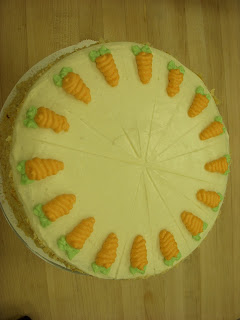
Anyway, the carrot cake we made had three layers. We used a cream cheese icing as the filling as well as for decorating. We also practiced some piping skills and formed small carrots on the top of each slice. My cakes are improving and I still have a long way to go but today was a generally good, stress-free day in class. Here's my cake:

Friday, October 22, 2010
Four Times Pastries
Bakeshop classes this week focuses on Laminated Doughs and Pastries also so I had four opportunities on Tuesday and Thursday to learn more and work on these types of delicious treats. I had a pretty great week doing so.
On Tuesday, in my Laminated Doughs class, we accomplished two tasks. First, we made another batch of puff pastry dough; this time, we used a table top dough sheeter to help roll out the pastry rather than just use rolling pins. This machinery is pretty awesome. We also made baklava from phyllo dough with our partner; Gilly and I chose to cut our baklava in triangle shapes, and they looked (and tasted) pretty amazing:

In Tuesday's Bakeshop class, we made croissant dough and manipulated danish dough. We learned three different ways to fold the danish dough - snails, eyeglasses, and S's. We then filled them with cherries and blueberries, and used a powdered sugar glaze:

In Thursday's Laminated Doughs class, we made palmiers and pithiviers. Palmiers are rolled puff pastry with sugar. They are a delicious buttery sugar pastry:

A pithivier is made from puff pastry dough. I cut a circle of puff pastry dough for the bottom. I then piped the filling of frangipane (which is made from almond butter), apricot marmalade, and crushed toasted almonds. Another circle of puff pastry is placed on top. I then sealed the sides, added egg wash, formed the fluted edges, and put the carvings on top using a circular disc as a guide for my paring knife. After baking, the final product looks like this:

My pithivier was a true success. Chef complimented my working approach for the product and my final result, saying it was the second best in the class, second only to his! It was such an amazing feeling to have produced a really fantastic product. Here's another photo where you can see more layer definition in the pastry:

In the afternoon, we made apple turnovers:

And, we made croissants:

I am still on a bit of a baker's high, or maybe it's just the combination of butter and sugar going to my brain!
Monday, October 18, 2010
New York Style
So, I am pleased to announce that I did not overwhip chantilly cream today! The fact is, I didn't whip any cream today, so there wasn't an opportunity to overwhip it. Haha. No seriously. Over the weekend, I made a cake with chantilly cream and I totally rocked the icing. I am getting better.
In class today we made a New York Style Cheesecake - that's why we didn't work with any whipped cream. It was really a fun, low-key, laid-back, stress-free day. Even with a midterm exam (which I dominated), it was a nice easy day in Cakes. I really needed that!
Here's a picture of my cheese cake:

We each had the chance to decorate the top of our cheese cakes with whatever fruit assembly we wanted.

Like I said, a pretty good day. Though we did calculate the amount of calories and fat grams in one slice of cheese cake. And basically, it's a ton. Like a whole day's worth of fat intake. It's kinda depressing to actually see the numbers. Seriously. Depressing.
But, I've never eaten a piece of cake and really cared about being healthy. So maybe it doesn't much matter. Moderation is key.
Saturday, October 16, 2010
Cookies
In my bakeshop classes on Tuesday and Thursday, we made a variety of cookies. On Tuesday, we made sugar, chocolate chip, gluten free peanut butter, and cowgirl cookies.

That's a picture of the great job I did scooping 84 cowgirl cookies, which have chocolate chips, pecans, coconut, and oats. As I was finishing my scooping, Chef discovered the container the oats came in had mold on the bottom of it. Those 84 cookies went right in the trash. Whoops.
My friend Anna made these great chocolate chip cookies:

And Mandy made the gluten free peanut butter:

On Thursday, we made different types of biscotti; I made almond flavored ones. And we decorated sugar cookies - which is not really my strong suit - and I would be more than happy to pay someone to do this for me in the future.

Laminated Doughs & Pastries
On Thursday, I welcomed my 29th birthday with a new class called Laminated Doughs and Pastries. The word "lamination" in the pastry world refers to layering a fat (usually butter) between two layers of pastry dough, and then using using different techniques to turn those three layers - dough, fat, dough - into multiple (sometimes hundreds) of layers. When the product is baked, the result has hundreds of crisp flaky layers such as in croissants.
During Thursday's class, we made Austrian Apple Strudel. We first made strudel dough and then prepared a filling with diced apples, cinnamon, cloves, nutmeg, walnuts, raisins, and cherries. This was an unbelievably amazing process. Chef demonstrated how the strudel dough can be stretched so thin that you could slide a piece of paper under it and read the paper. Here's what I'm talking about:

Seriously, we started with just over a pound of dough and were able to stretch it this thin without putting holes in it. It is pretty amazing. After stretching the dough, it is buttered. My friend Gilly took this photo, and again you can see just how far we were able to stretch this dough:

After adding the butter, we layered panko bread crumbs. Along the edge of the dough, we placed the apple filling in a line, and then began to roll the dough with the help of the tablecloth. Unfortunately, I don't have a photo of the product after rolling, but you can imagine that it was the width of the table and rolled about 10 times. In this sense, the lamination comes through the rolling process, when the dough and butter become rolled over the filling. Here's the finished product with Chef's presentation:

During class, we also began to prepare Puff Pastry, which we'll make often and use often throughout the course. We prepared the puff pastry dough by mixing and kneading it by hand, and placed it in the cooler. Puff pastry dough needs to be extremely cold to work with. After it had time to chill, we took 2.5 lbs of butter and created a butter block. To create a butter block, you basically take a rolling pin and beat the butter into a sheet. The butter also must be cold for this process. A high quality butter will maintain its shape and become pliable. We were then able to knead the butter like we would knead dough. Once the butter block was prepared, we rolled the puff pastry out into a rectangle, and placed the butter block onto half of the dough. We then folded the second half of dough over the butter, so we had three layers - dough, butter, dough. Throughout the class, we performed different folds with the puff pastry dough. After the first fold, we ended up with 12 layers. After the second fold, we ended up with 36 layers. After the third fold, we ended up with 144 layers. And we still have one more fold to do next week. It's quite fascinating to know and see how puff pastry becomes so flaky. Can anyone guess how many layers we'll have after the fourth and final fold on Tuesday?
On a side note, I already have a hugh appreciation for people who make and sell product made from puff pastry. Once you actually see the amount of time and energy that goes into the process, it's certainly understandable how these products are able to be sold for a higher price. The labor (and labor of love) is intense.
Subscribe to:
Posts (Atom)